Amazon

Tuesday, 16 September 2014

India to enter Mars orbit on September 24

An Indian spacecraft will enter Mars on September 24 for scientific exploration of the red planet after a 300-day voyage through inter-planetary space, an ISRO official said on Monday.
“After cruising through 666-million km across the solar orbit, for over nine months, our spacecraft will be inserted into the Martian orbit on September 24 at 7.30 a.m.," Indian Space Research Organisation (ISRO) scientific secretary V. Koteswara Rao said here at a preview of the mission’s tryst with the celestial object.
The orbit insertion will take place when the spacecraft will be 423 km from the Martian surface and 215 million km away (radio distance) from the earth.
The ambitious Rs. 450-crore ($70 million) Mars Orbiter Mission (MOM) was launched November 5, 2013 on board a polar rocket from the spaceport Sriharikota off the Bay of Bengal, about 80 km north-east of Chennai.
“India will be the first country in the world to insert a spacecraft into the Martian orbit in its maiden attempt if the operation succeeds and also the first Asian country to reach the red planet’s sphere,” Mr. Rao said.
The ISRO will be the fourth space agency after National Aeronautics and Space Administration (NASA) of the U.S., Russian Federal Space Agency (RFSA) and European Space Agency (ESA) to have undertaken a mission to Mars.
Incidentally, NASA’s Mars Atmosphere and Volatile Evolution Orbiter (MAVEN) will enter the red planet’s orbit Sep 22.
In the run-up to the D-day, the mission scientists will do course (trajectory) correction on September 22.
As on Monday, the 475 kg (dry mass) spacecraft is 13 million km away from Mars, having cruised 98 per cent (201 million km) of the radio distance from the earth and 653 million km of the sun’s 666 million km orbit.
“The course correction has been postponed to September 22 from Sunday (September 14) to conserve the precious liquid fuel weighing (852 kg) and ensure the orbital insertion takes place when the spacecraft is closer to Mars for smooth transition from the sun’s orbit,” Mr. Rao said.
Scientists at the spacecraft’s control centre have started uploading commands since Sunday and will verify them late Monday.
During the Orbiter’s long journey, mid-course correction was carried twice — Dec 11 and June 11 — but skipped in April and August as it was cruising in the solar orbit as intended.
“The liquid apogee motor (LAM) or fuel engine at the bottom of the spacecraft will be fired on September 22 for four seconds to enter the Martian sphere of influence and the course correction will consume about 500gm of fuel,” Mr. Rao said.
The speed of the spacecraft will also be reduced to 2.14 metre per second from 22.2 km per second for enabling smooth transition into the Martian orbit from the sun’s orbit Sep 24.
The insertion operation will begin at 4.17 a.m. by first activating the spacecraft’s three antennas for receiving and transmitting signals between earth and Mars.
At 6.56 a.m., the spacecraft will be rotated towards Mars and five minutes later when sunlight is not falling on the Martian surface causing eclipse, the thrusters beneath the engine will give the Orbiter altitude control.
“The liquid engine will start firing at 7.17 a.m. and at 7.21 a.m., Mars occult begins. A minute later at 7.22 a.m., telemetry (radio signals) will be off or out of receiving radars on the earth,” Mr. Rao pointed out.
Scientists at the space agency’s deep space network at Byalalu, about 40 km from Bangalore, NASA’s Earth station at Goldstone on the U.S. west coast, the ESA’s Earth station at Madrid will confirm the insertion into the Martian orbit 24 minutes later at 7.54 a.m.
“Telemetry signals resume and Doppler measurements will provide first signals about the successful insertion of the spacecraft into the Martian orbit,” Mr. Rao added.
The spacecraft, with five scientific instruments, will be placed in an elliptical orbit, with the nearest distance from the Martian surface being 423 km and the furthest 80,000 km, to rotate around it in a duration equivalent to 3.2 earth days.

Searching of the missing 'i' in Apple's Watch


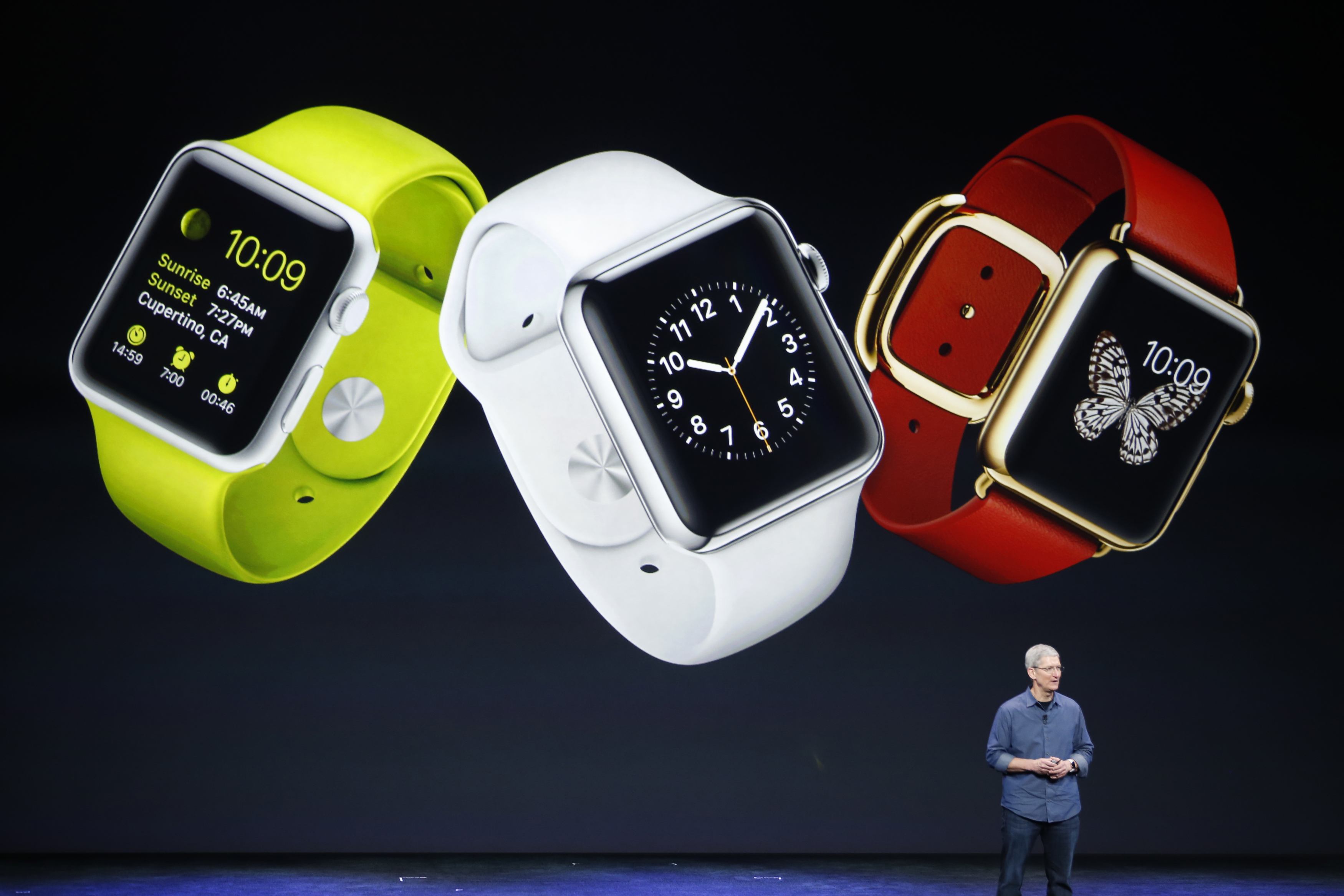
Apple Inc.'s Tuesday launch was a marketing extravaganza stuffed full of gadgets, corporate hyperbole and celebrities of every stripe. One thing was missing: the "i" in front of the Watch.
The company that spends hundreds of millions of dollars marketing and advertising its gizmos does not do things without careful deliberation. Some branding experts say Apple chose that foreshortened appellation both to distinguish its first new device in four years and send a message to the public that it was moving into new territory.
Others say the absent alphabet may signify the Watch's positioning for now - as an accessory and companion to the iPhone, which it requires in order to work, rather than a product that exists on its own merits.
Apple did not respond to a request for comment.
"They are looking down the road," said Robert Passikoff, president of Brand Keys, New York- based brand research consultancy. "The watch is going to be an adjunct to a lot of other things that will still have the 'i' attached to them. All of this wearable technology stuff really isn't stand alone."
“It becomes more of an app attachment than a single product," Passikoff said.
But the Watch may carry higher stakes for the company and CEO Cook.
Cook, who has laboured for years under the shadow of his legendary predecessor Steve Jobs, on Tuesday kept the Watch for last, unveiling the first device to be developed under his tenure with a hint of emotion in his voice. Before the unveiling, he had stressed the historic significance of the Flint Centre venue - where a young Jobs unveiled the Macintosh decades ago.
Now, the company that waded into smartphones in 2007 and tablets in 2010 is again venturing into unfamiliar territory, though this time the inherent demand is less than certain. IT research outfit IDC experts predict around 42 million smartwatches will be sold in 2015; Apple sometimes sells that many iPhones in three months.
The financial impact for the company remains unclear, but analysts say the success of the Watch will help restore some shine to its dimming reputation for innovation. In past years, Apple had appeared stuck in an iPhone product cycle, with a new version typically launched in the second half and a more complete redesign only every two years.
That elevates the importance of the timepiece. Marketing chief Phil Schiller once said in court that Apple's strategy, which spends hundreds of millions of dollars on ads, is to "make the product the biggest and clearest thing in advertising."
"It is a new era," said Ellen Leanse, a brand strategist and former senior Apple executive. "It was a highly confident move that signals, pardon the pun, watch us."
"It would have been trite to call it the iWatch. It would have been looking backwards," she added. "This could pave a new path for a product family" like the Macintosh.

Using bond money, Chattanooga, Tennessee created Internet speeds 200x faster than the US standard!

And I can't even get my cat videos to play properly.
Thanks to a substantial bond and stimulus initiative in 2008, Chattanooga, Tennessee became one of the first cities in America to offer Gigabit Internet.
Unlike standard forms of broadband Internet, where most users have access to around five megabytes per second (mbps) for downloading content, Gigabit services offer users at least 1000 mbps.
To put that in perspective, Gigabit users can download an HD movie in less than ten seconds, while it will take the average American over 20 minutes. This means that, in Chattanooga, users signed up for Gigabit Internet get speeds that are 200x faster than the national standard.
Thankfully, other cities are following Chattanooga's example. Google Fiber, a competing Gibabit Internet service, is currently available in Kansas City, Austin, and Provo, with plans to expand into Portland, San Jose, Salt Lake City, Phoenix, San Antonio, Nashville, Atlanta, Charlotte, and Raleigh-Durham.
Currently, though the United States is home to most major Internet corporations, it only has the 26th best Internet speeds in the world. Perhaps that fact will change as Gigabit services become more available.

Read more at http://www.omgfacts.com/category/5/Technology#XZgMquUFOJD1UJyq.99

Android One smartphone sales to hit 2 million in 2014: MediaTek


NEW DELHI: Buoyed by the initial response to Android One smartphones, chipmaker MediaTek has said it expects as many as two million handsets to be sold this year in India, the world's second largest market for mobile phones.

The Taiwan-headquartered company has partnered with US-based tech giant Google on Android One, an initiative to provide a family of high-quality yet affordable Android devices for consumers in emerging markets like India.

Yesterday, Google launched three devices in partnership with Micromax, Karbonn and Spice under the Android One initiative. India is the first country to have the Android One handets, priced at Rs 6,399 onwards.

"We expect 1.5-2 million Android One handsets to be sold this year in India," MediTek VP (US business development) Mohit Bhushan told PTI when asked about the his expectations on the sale of the handsets.

With prices starting at Rs 6,399, the hardware and software being provided on Android One will give users an amazing experience, he added.

The first set of Android One devices feature MediaTek's MT6582 mobile System-on-Chip (SoC), which is based on quad ARM CortexTM A7 CPU architecture.

The processors deliver superior multitasking performance and excellent sustained performance-per-watt for a premium mobile experience.

When asked about the impact on Android One on the smartphone market, Bhushan said: "In the short term, there can be disruptions. But, this will eventually lead to handset makers not part of Android One to invest on innovating the mobile experience."

He added that companies will have to realize that Android One will give users an unmatched device experience at affordable prices and for them to match it, they will have to follow suit.

With Android One, Google aims to win customers in the world's fastest growing smartphone market with low prices and better quality software.

Currently, many affordable smartphones in India already offer customized versions of the Android operating system.

In case of Android One, the eventual software upgrades on the Android One phones would come directly from Google. This would give Google better control of the operating system and ensure users get a consistent service.

Reports suggest, an initial lot of Micromax Canvas A1 handsets, that were put up for sale on Amazon, were sold out.

PwC India Leader (telecom) Mohammad Chowdhury said: "The festive season regularly sees an uptick in handset sales and we should expect this in the next few months. In particular there is hot competition in the segment priced from Rs 7,000 upwards."

App to help lose weight

If you plan to lose weight, some apps can do the job for you more efficiently by reliably tracking dietary data and preparing what suits your body the most, say researchers.

Smartphones may offer users an advantage over traditional methods when tracking diet data, a team from Arizona State University found.

For the study, researchers recruited healthy adults and randomly divided them into groups based on their diet-tracking method.

The groups consisted of those who used the “Lose It!” app, those who recorded dietary intake using the memo function of their smartphone and those who used traditional paper and pencil to record their diet.

Although smartphone use did not affect total weight loss among the 47 participants who completed the study, researchers observed better diet tracking results among those in the smartphone use groups.

The memo and paper and pencil groups reported twice the number of missing days as the group using the app.

“Participants using a commercially available app more consistently entered complete days of dietary data compared with the paper-and-pencil group and also withdrew from the study less often than the other groups,” explained lead author Christopher Wharton.

“It is possible that app technology offers a less burdensome method for tracking data compared with traditional tools,” he added.

Intel launches kids tablet Eddy in India

California-based chip-maker Intel and Metis Learning have launched a tablet for children aged 2-10 priced at Rs9,999, an official said.

"The technology landscape is changing in India. Tablets can be used as a learning tool. The kids tablet Eddy, combines an ideal balance of performance and battery life coupled with strong learning content to provide an innovative and exciting solution for kids," Sandeep Arora, Intel South Asia director, marketing, said.

Bharat Gulia, co-founder of Metis Learning Solutions, told IANS the company has done a pilot project for the tablet with 500 children.

"We have spent 2 to 3 years creating this and building solution. It is very important to give kids something that is engaging. These years of their lives are the best potential years," he said.

Eddy comes with Android 4.2 and has an internal storage of 16 GB and can be expanded up to 32 GB. It comes pre-loaded with over 160 learning apps selected by educators and experts to accelerate a child's social, emotional and cognitive development.

The size of the tablet market in India is 4 million and of that 10% is the children's tablet market.

"We are trying to tie-up with schools and pe-schools for this tablet. Especially pre-schools are showing a lot of interest," Gulia said.

Eddy will be available in e-commerce portal Amazon for around a month, following which it will be available in retail stores, he said.

Alibaba Raises IPO Price Range

NEW YORK (AP) — Alibaba now plans to raise up to $25.03 billion in its upcoming IPO, making what was expected to be the biggest stock market debut even bigger.
The Chinese e-commerce company said it still plans to sell 368.1 million shares, but at $66 to $68 apiece, according to a regulatory filing, instead of its previously set range of $60 to $66 apiece.
Alibaba Group Holding Ltd. has emerged as a hot commodity because of its e-commerce bazaar, a shopping magnet for businesses and consumers alike as China's economy steadily grows. The company's network of sites includes Taobao, Tmall, and AliExpress, as well as Alibaba.
Most of Alibaba's 279 million active buyers visit the sites at least once a month on smartphones and other mobile devices, making the company attractive to investors as computing shifts away from laptop and desktop machines.
Investors have been salivating over the trifecta of growth that Alibaba offers: "There are very few companies that are this big, grow this fast, and are this profitable," said Wedbush analyst Gil Luria. He initiated coverage on the company with a 12-month price target of $80.
The company's revenue in its latest quarter ended June 30 surged 46 percent from last year to $2.54 billion while its earnings climbed 60 percent to nearly $1.2 billion, after subtracting a one-time gain and certain other items.
Alibaba has been meeting with potential investors over the past week, and demand spurred the increase. Alibaba is expected to be priced late Thursday and start trading Friday under the ticker 'BABA' on the NYSE.
The fundraising target eclipses the $16 billion Facebook raised in 2012, the most for a technology IPO. It also would top the all-time IPO fundraising record of $22.1 billion set by the Agricultural Bank of China Ltd. in 2010, according to the research firm Dealogic.