Amazon

Sunday, 1 June 2014

Hennessey Venom GT: 270 miles per hour (434.5 kilometers per hour)

Hennessey, a boutique automaker based in Sealy, Texas, mainly used components from other manufacturers to create its super-fast Venom GT. That's fine, according to the generally accepted definition of a production car: As long as a specific quantity -- at least 30 -- are built. However, 30 Venom GTs don't exist yet, and the company says it plans to build only 29. So a hand-built vehicle consisting of a stretched Lotus Exige body and a 7-liter, Corvette ZR-1 engine, boosted by two turbochargers, may or may not be a legit contender, depending on who you ask. On Feb. 14, 2014, the Hennessey Venom GT set out to take down the Bugatti Veyron Super Sport, anyway.The Hennessey Venom GT is so fast it needed to borrow real estate from NASA. That's right. The space shuttle's landing strip was the setting for the Venom GT's 270.49-mile-per-hour (435.3-kilometer-per-hour) run. However, John Hennessey, the company's founder, said that NASA only allowed one run, making it ineligible for the Guinness record based on the back-to-back run standard. Even if the result isn't official, the Venom GT's GPS-qualified run stole some of the Veyron Super Sport's thunder.

Saturday, 31 May 2014

Love Music? Here's something for you

There are times when you’ve heard every song in your phone’s library twice and are desperate for new music. Or you have a song stuck in your head but you can’t listen to it just because you forgot to save it to your phone. Well, fret no more. Now you can just pick up one of these apps and get the music you want.
SoundCloud
SoundCloud is a social sound platform, where artists — both established and up-coming ones — upload hours of new music. With the app, you can take all the music you want with you on the go; it live-streams tracks or playlists over your WiFi or data connection and lets you follow music and podcast creators (you can even search for audiobooks or their excerpts). My favourite feature is the lockscreen playback — it lets you play, pause or skip tracks without having to unlock your screen. Not just that, you can also record and share your own music through your smart phone . So bring your singing out of the shower.
Grooveshark
This app lets you play songs or even entire albums. You can make and save playlists and access them from anywhere — your phone or computer as it’s synced over the cloud. Grooveshark makes radio stations based on the music you already like, so you can discover new tunes and chances are, you’ll love them. My favourite feature is the Listen Offline — you can ‘offline’ your favourite songs and listen to them even when your data coverage falters.
SoundHound
You love that song playing in the restaurant, but you don’t know which one it is. Well, our friend SoundHound here can sniff it out for you. The app recognises the music playing around you and let’s you tap the SoundHound button to instantly identify the song and see its lyrics, share, or buy it. You can even search for it by singing or humming into the mic. But, if you can’t carry a tune, ouch!
Raaga
Remember the time when a lot of mothers learnt how to navigate the Internet and spent all their time and bandwidth on raaga.com? Well, now that they’re learning how to handle their smartphones, raaga.com is ready with its official app. It offers songs in over 20 Indian languages including Hindi, Tamil, Telugu, Marathi, Punjabi, Malayalam and Bhojpuri. The app even offers Carnatic and Hindustani music and also claims to have the largest archive of devotional content. Not just that, it lets you access your saved playlists and also search for and discover new music.
Poweramp
Poweramp is a music player that claims to have been the number one paid music player in the Google Play Store for three years running. Yup, that’s the catch, it’s a paid app. However, it offers a 15-day free trial, and I have to say, after that period, one is rather tempted to buy it. Poweramp plays mp3, mp4/m4a (incl. alac), ogg, wma, flac, wav, ape, wv, tta, mpc and aiff files. It has a 10-band optimised graphical equaliser for all supported formats, presets, custom presets; separate Bass and Treble adjustment; and stereo eXpansion, mono mixing and balance. It also supports lyrics, including lyrics search via a musiXmatch plugin, has OpenGL based cover art animation and even downloads missing album art. So next time you’re asked to DJ a party, just create your playlist and play on.

Cars With No Steering Wheel: Google

Google is building a car without a steering wheel.

Sergey Brin, co-founder of the technology titan, told a Southern California technology conference on Tuesday evening that Google will make 100 prototype cars that drive themselves and therefore do not need a wheel. Or brake and gas pedals.

Instead, there are buttons for go and stop.

A combination of sensors and computing power takes the driving from there.

To date, Google has driven hundreds of thousands of miles on public roads with Lexus SUVs and Toyota Priuses outfitted with the special equipment.

This prototype is the first Google will have built for itself.

It won’t be for sale, and Google is unlikely to go deeply into auto manufacturing. In a blog post, the company emphasised partnering with other firms.

Tuesday, 15 April 2014

More veggies in space

Astronauts will now turn into cosmic gardeners and grow lettuce in space as United States space agency National Aeronautics and Space Administration (NASA) is all set to send the largest ever plant growth chamber to the International Space Station (ISS).

It will launch the Vegetable Production System aboard SpaceX’s Dragon capsule on Monday.

The plant growth chamber will grow lettuce inside prototype flight pillows that will help the plants withstand zero gravity, The Verge reported. Red, blue, and green light emitting diodes (LEDs) will help sustain the vegetables, and the plant chamber itself can grow to 11.5 inches wide and 14.5 inches deep, NASA said.

This will be “the largest plant growth chamber for space to date,” according to NASA payload scientist Gioia Massa.

The project was originally slated to launch late last year, but faced delays meant to ensure all safety precautions were taken, the report said.

It is now hoped that the chamber will eventually be used to grow a wider variety of vegetables, and even be used for recreational gardening, the report said.

The chamber may even be used for more ambitious projects, like providing food for the average person back on Earth. After extensive testing on weightless horticulture, NASA is confident the lack of gravity will not impede growth.

However, space-borne microbes that may develop during growth are a cause of concern. Therefore, the lettuce will undergo extensive testing before astronauts chow down.

Twitter users can now tag friends in photos

Twitter users can now tag their friends in pictures.

Long available in other social networks, the new service is part of an update of the Twitter app for iOS and Android that is now available.

Users can tag up to 10 friends in a picture and still have 140 characters to write a tweet, says the company.

Anyone who doesn’t want to be tagged can remove the label later or even block tags entirely. The update also allows users to include up to four pictures with a tweet. Previously, the limit had been one photo.

Thursday, 27 March 2014

BlackBerry gets clearance for security solution in US


BlackBerry said it received US government security clearance for its solution that separates and secures work and personal data on mobile devices powered by Google's Android platform and Apple's iOS operating system.

The Federal Information Processing Standard (FIPS) 140-2 certification, a coveted US government security clearance, will allow government agencies to deploy the new devices as soon as they are launched.

The certification will encourage BlackBerry's large customers to continue to use its services, even as employees seek to support their personal devices on corporate networks, which could create security breaches.
 

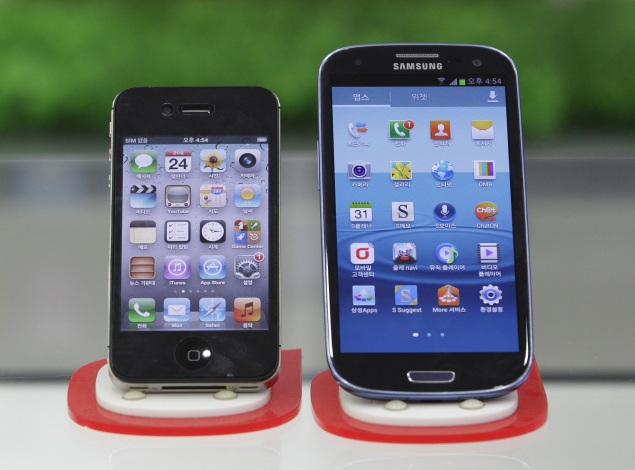
Apple wins patent ruling against Samsung in Japan

Apple has won another legal bout against Samsung in its ongoing patent row.
The move comes as Tokyo District Court Judge Koji Hasegawa ruled that Apple's iPhone 4S, iPhone 4, and iPad 2 did not infringe on patents held by Samsung related to data communications.
After the ruling, in a statement, Samsung said it will analyze the decision and possibly appeal it, addi The company added that it is disappointed with the court's ruling.
According to CNET, Samsung had argued that the devices were violating its intellectual property and it should be compensated in damages for the alleged infringement.
Apple and Samsung are in a bitter patent dispute for the last few years. The two companies have been urged by courts around the world to put an end to their patent disputes.
However, the companies have decided to continue to battle it out in court.